
In mathematics, slope is a fundamental concept that describes the “steepness” and direction of a line. Whether you are studying algebra, calculus, or simply looking at the pitch of a roof, understanding slope is essential.
1. What is Slope?
The slope of a line is a number that measures how much the $y$-value (vertical) changes for every unit change in the $x$-value (horizontal). In simpler terms, it is the ratio of the “rise” to the “run.”
- Rise: The vertical change between two points (up or down).
- Run: The horizontal change between two points (left or right).
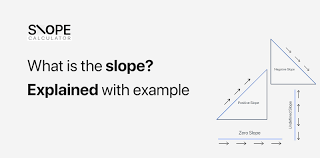
The Four Types of Slope
- Positive Slope: The line goes up from left to right.
- Negative Slope: The line goes down from left to right.
- Zero Slope: A perfectly horizontal line.
- Undefined Slope: A perfectly vertical line (since you cannot divide by a “run” of zero).
2. Fundamental Formulas
The Slope Formula (Two-Point Formula)
If you have two points on a line, $(x_1, y_1)$ and $(x_2, y_2)$, the slope ($m$) is calculated as:$$m = \frac{y_2 – y_1}{x_2 – x_1}$$
Slope-Intercept Form
In the most common linear equation format, the slope is represented by the letter $m$:$$y = mx + b$$
- $m$ = Slope
- $b$ = $y$-intercept (where the line crosses the vertical axis)
3. Advanced Concepts: Parallel & Perpendicular
Parallel Lines
Two lines are parallel if they never intersect. For this to happen, they must have the exact same steepness.
- Rule: $m_1 = m_2$
- Example: The lines $y = 3x + 5$ and $y = 3x – 10$ are parallel.
Perpendicular Lines
Two lines are perpendicular if they intersect at a right angle ($90^\circ$). Their slopes are “negative reciprocals” of each other.
- Rule: $m_1 \cdot m_2 = -1$ (or $m_2 = -\frac{1}{m_1}$)
- Example: If a line has a slope of $4$, the line perpendicular to it has a slope of $-\frac{1}{4}$.
4. Real-World Applications
- Architecture: Determining the “pitch” of a roof so rain and snow slide off.
- Civil Engineering: Designing the “grade” of a road. A $6\%$ grade means the road rises $6$ feet for every $100$ feet of horizontal distance.
- Economics: Calculating the “marginal cost”—the cost of producing one additional unit.
5. Slope Practice Quiz (Expanded)
Q1. Basic Calculation: Find the slope of the line passing through $(2, 3)$ and $(5, 12)$.
Q2. Parallel Logic: Line $A$ passes through $(0, 0)$ and $(2, 4)$. Line $B$ is parallel to Line $A$. What is the slope of Line $B$?
Q3. Perpendicular Challenge: A line has the equation $y = \frac{2}{3}x + 4$. What is the slope of a line perpendicular to it?
Q4. Word Problem (The Hiking Trail): You are hiking up a mountain. You start at an elevation of $500$ meters. After walking $2,000$ meters horizontally, your elevation is $1,100$ meters. What is the average slope of the trail?
6. Answer Key
- Answer: 3. Calculation: $m = \frac{12 – 3}{5 – 2} = \frac{9}{3} = 3$.
- Answer: 2. Calculation for Line A: $m = \frac{4 – 0}{2 – 0} = 2$. Since they are parallel, Line B also has a slope of $2$.
- Answer: $-\frac{3}{2}$ (or -1.5). The negative reciprocal of $\frac{2}{3}$ is $-\frac{3}{2}$.
- Answer: 0.3. Calculation: $\text{Rise} = 1,100 – 500 = 600$. $\text{Run} = 2,000$. $m = \frac{600}{2,000} = 0.3$.
Quick Summary Table
| Feature | Description |
|---|---|
| Symbol | $m$ |
| Concept | $\frac{\text{Rise}}{\text{Run}}$ |
| Parallel | $m_1 = m_2$ |
| Perpendicular | $m_1 = -\frac{1}{m_2}$ |
| Horizontal | $m = 0$ |
| Vertical | Undefined |