
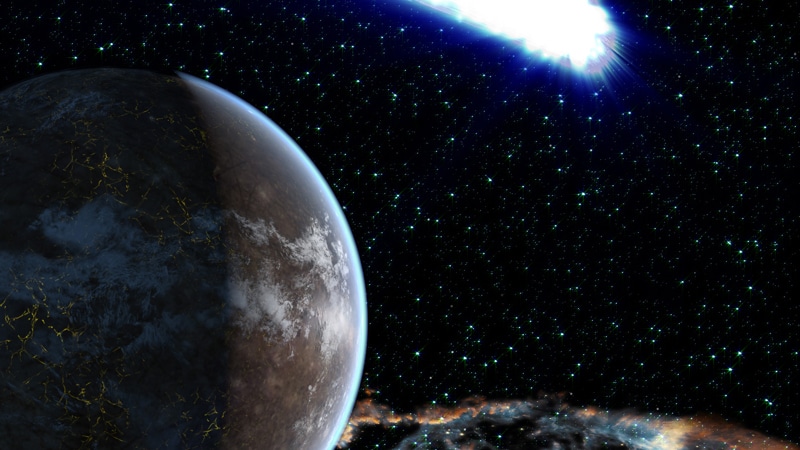
Have you ever looked up at a clear, dark night sky and felt a profound sense of wonder? You aren’t alone. For millennia, humans have stared at the stars, using them to navigate oceans, time their harvests, and ponder the very nature of existence.
Astronomy is often called the “sublime science.” It’s a field that scales from the microscopic particles of stardust to the incomprehensible vastness of the observable universe. If you’ve ever wanted to tell a planet from a star or understand what “light-years” actually represent, this beginner’s guide is for you.
What Exactly is Astronomy?
At its simplest, astronomy is the study of everything outside Earth’s atmosphere. This includes the Moon, the planets in our solar system, the stars that make up our galaxy, and the billions of other galaxies scattered across the void.
It is distinct from astrology, which is a belief system suggesting that the positions of celestial bodies influence human affairs. Astronomy is a rigorous branch of science that uses physics and mathematics to explain the “how” and “why” of the universe.
The Three Pillars of the Beginner’s Sky
To understand the universe, astronomers generally look at three different scales:
1. Our Solar Neighborhood
This is our “backyard.” It consists of our Sun and everything bound to it by gravity:
- The Eight Planets: From the scorched surface of Mercury to the icy winds of Neptune.
- Moons: Like our own Moon or Jupiter’s volcanic Io.
- Asteroids and Comets: The “leftovers” from the formation of our solar system.
2. Stars and the Milky Way
Beyond our solar system lie the stars. When you look at the night sky, every single star you see with the naked eye is part of our own galaxy, the Milky Way. You’ll learn about the life cycles of these giants—how they are born in clouds of gas (nebulae) and how some eventually collapse into black holes.
3. The Deep Universe (Cosmology)
This is the big picture. Cosmology looks at the origin, evolution, and eventual fate of the entire universe. It involves the study of distant galaxies, dark matter, and the Big Bang Theory, which posits that the universe began as a single point and has been expanding for roughly $13.8$ billion years.
Essential Concepts to Know
Before you grab a telescope, there are a few “Astronomer’s Rules of Thumb” that make the sky easier to navigate:
- Distance is Time: Because light takes time to travel, looking at distant stars is literally looking back in time. The light from the Sun takes $8$ minutes to reach us; the light from the nearest star system, Proxima Centauri, takes $4.2$ years.
- The Celestial Sphere: Think of the sky as a giant transparent globe surrounding the Earth. Even though stars are at different distances, they appear to be “fixed” on this sphere.
- Magnitude: This is how we measure brightness. Interestingly, the lower the number, the brighter the object. The Sun has a magnitude of $-26.7$, while the North Star (Polaris) is about $+2.0$.
How to Start Stargazing Today
You don’t need a multi-million dollar observatory to be an astronomer. In fact, many professional discoveries are made by amateurs!
- Use Your Eyes: Spend time learning the “anchor” constellations like Orion or the Big Dipper (Ursa Major). They act as landmarks to help you find smaller objects.
- Download a Star Map: Apps like Stellarium or SkyView use your phone’s GPS and compass to show you exactly what you’re looking at in real-time.
- Invest in Binoculars First: A good pair of $7 \times 50$ or $10 \times 50$ binoculars is often better for a beginner than a cheap telescope. They offer a wider field of view and are much easier to point.
- Seek Dark Skies: Light pollution from cities washes out the faint glow of the Milky Way. Use a “Dark Sky Map” to find a local park or rural area where the stars can truly shine.
The Final Frontier
Astronomy 101 isn’t just about memorizing facts; it’s about perspective. When you realize that there are more stars in the universe than grains of sand on every beach on Earth, your daily worries tend to feel a little more manageable.